
AI Chip Stock Sell-Off Intensifies as Semiconductor Index Enters Bear Market Territory
The AI chip stock sell-off deepens as the semiconductor index enters bear territory. Chinese AI competition and spending concerns drive global market declines.
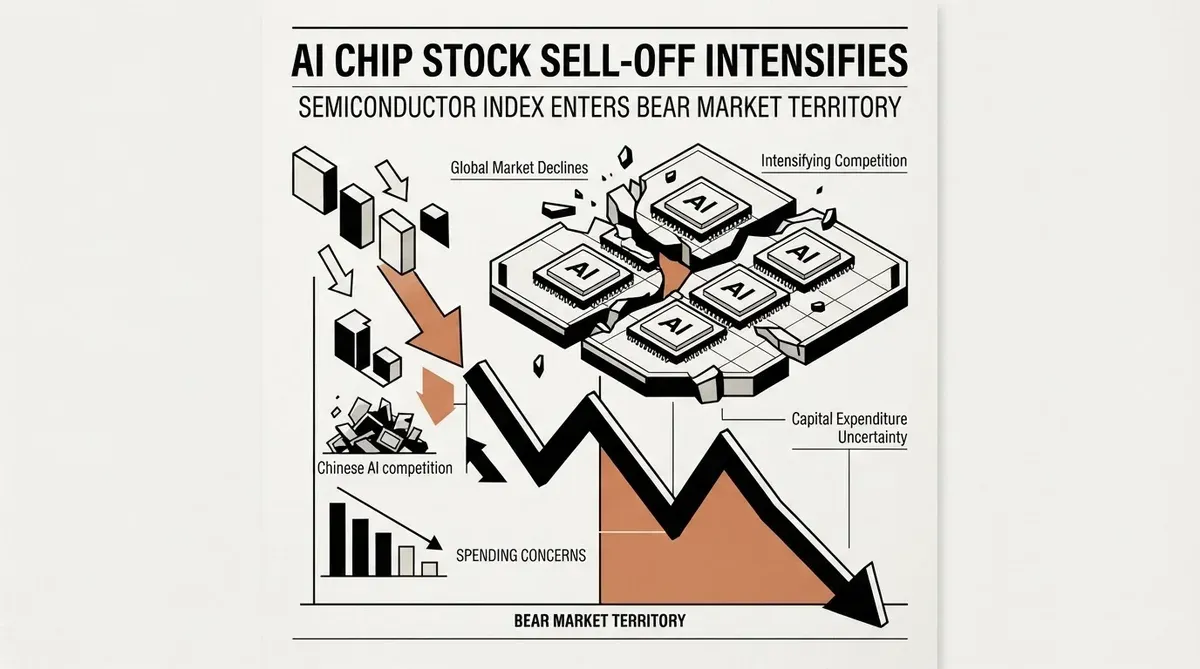
The AI chip stock sell-off deepened markedly this week, pushing the Philadelphia Semiconductor Index more than 20 percent below its late-June record and into technical bear market territory. The decline marks a turning point in investor sentiment, as the market begins to question the assumptions behind the months-long rally. Stock markets from Seoul to New York posted sharp losses Friday as investors confronted a dual challenge: Chinese AI competition narrowing the technology gap, and mounting questions about the financial returns from the industry's unprecedented infrastructure spending.
Chinese AI company Moonshot triggered the latest leg of the decline by unveiling Kimi K3, a model that closes much of the performance gap with Western frontier systems such as OpenAI's ChatGPT and Anthropic's Claude. The announcement intensified existing concerns that the massive capital outlays behind the AI buildout, much of it debt-financed by hyperscale cloud providers, may not translate into durable competitive advantages or proportional revenue growth.
Asia Bears the Brunt of the Rotation
Asian markets, which house the bulk of the world's semiconductor manufacturing and memory production, suffered the steepest losses. Taiwan's main stock gauge lost more than 6% in Friday trading. Japan's Nikkei fell 4 percent. South Korea's KOSPI dropped 5 percent in a single session, with sector giants Samsung Electronics and SK Hynix tumbling 7.5 percent and 9.2 percent respectively.
The MSCI emerging-markets index dropped 1.8% on Friday and is down 3% for the week, dragged primarily by technology-heavy Asian indices. TSMC, a key AI bellwether, declined after releasing a spending outlook that investors considered too high relative to near-term demand signals. The sell-off across Asia was particularly severe because the region is home to the foundries, memory fabs, and packaging facilities that form the physical backbone of the AI supply chain.
Wall Street Follows Asia Lower
The sell-off carried into Friday's U.S. trading session. The Nasdaq Composite lost 1.5% on the day, and the S&P 500 declined 0.7%. The Philadelphia Semiconductor Index dropped more than 2 percent, pushing its month-to-date losses to roughly 20 percent, the threshold that market participants treat as a bear market for the sector. The index had already fallen 7.9 percent in a single session in late June during an earlier wave of AI spending concerns, and this week's selling extended those losses.
Among individual names, memory-chip maker Micron Technology has fallen about 30 percent from its record high. Shares of Nvidia, AMD, Broadcom, Intel, and Marvell all moved lower in Friday trading. Equipment makers Applied Materials and Lam Research each declined more than 4 percent. Western Digital fell more than 3 percent, and Sandisk dropped more than 2 percent. Qualcomm also retreated in the broad-based decline.
The rotation was not limited to chipmakers. Microsoft shares entered bear market territory this month, falling more than 20 percent from their June 1 peak. The stock is down 23 percent year to date, a decline that highlights how even the most prominent AI-platform companies have not been immune to the revaluation. The broader Nasdaq has fallen more than 6 percent from its all-time high set on June 2, paring a blistering rally that had pushed the index up more than 30 percent over the prior year.
Anatomy of the AI Chip Stock Sell-Off
This week's decline is not a routine pullback within an ongoing rally. It is a broader reassessment of the economics behind the AI infrastructure buildout, driven by multiple reinforcing factors that began to surface in late June.
Investors are focusing on the scale of debt-financed capital expenditures from hyperscale cloud providers, who have committed tens of billions of dollars to data centers and GPU clusters. The concern is straightforward: if these investments do not generate proportional revenue growth, the returns on invested capital will fall, justifying lower valuation multiples across the supply chain.
The emergence of competitive Chinese models such as Moonshot's Kimi K3 adds a strategic dimension to the financial calculation. If capable frontier models can be built with meaningfully less capital than Western incumbents have spent, the argument for ever-expanding chip demand weakens at the margin. The semiconductor industry's bull case has rested partly on the assumption that only U.S. and allied companies possess the resources to train frontier models, making the spending addressable market effectively captive.
The sell-off has erased more than a trillion dollars in market capitalization across the semiconductor sector, according to published estimates. The VanEck Semiconductor Index has fallen 13 percent over ten consecutive trading sessions, while the iShares Semiconductor ETF has posted comparable losses. Some of the hardest-hit stocks are the same names that led the rally. Momentum-driven funds that amplified the upside are now amplifying the downside as they unwind concentrated positions.
The rotation out of technology names has been broad and persistent. Investors have redirected capital into banking stocks, where strong earnings from major U.S. lenders including JPMorgan and Goldman Sachs offered a safer yield. South Korea's technology sector has been particularly exposed given its concentrated exposure to memory and AI supply chains. Samsung Electronics' better-than-expected quarterly results earlier this month paradoxically triggered a wave of selling, as institutional investors used the liquidity to exit positions rather than accumulate more.
Even before this week's sell-off, the warning signs were visible. The Philadelphia Semiconductor Index fell 7.9 percent on June 23 alone, and the Nasdaq closed at multi-week lows that day as concerns over hyperscalers' debt-funded spending first surfaced. Friday's trading pushed those earlier losses into a sustained trend rather than a one-off event.
What Comes Next
The near-term direction depends on whether the sell-off reflects a healthy correction within an extended bull run or the beginning of a more sustained repricing. Earnings reports from major cloud providers in the coming weeks will be watched closely for signals about capital expenditure plans and the revenue trajectory of AI services. If hyperscalers signal a slowdown or a shift in prioritization, the AI chip stock sell-off could deepen further. If they reaffirm their spending commitments alongside evidence of revenue generation, the market may stabilize.
Geopolitical factors add another layer of uncertainty. Rising oil prices tied to renewed Middle East tensions this week contributed to a broader risk-off mood, compounding the pressure on equities. The combination of AI valuation questions, rising energy costs, and monetary policy uncertainty creates an unusually wide range of outcomes for semiconductor stocks heading into the second half of the year.
Why This Matters
The AI chip stock sell-off is the first major test of the valuation thesis that has powered equity markets for over a year. A sustained decline in chip stocks raises the cost of capital across the AI ecosystem, affecting everything from data-center construction to startup financing. For business leaders and investors, the message is direct: the market is demanding proof that AI infrastructure spending converts into revenue and profit, not just technical milestones. The next few earnings cycles will reveal whether this repricing is a temporary reset or a lasting shift in how the market values AI's industrial base.
AI-generated image.
Related Articles
- AI Chip Stocks Set H1 Records Then Suffer Worst Correction
- NVIDIA H200 China Sales Hit Zero as Beijing Blocks Domestic Tech Giants from U.S. Chips
- Memory Chip Crisis Drives Apple and Microsoft to Raise Prices Up to $300
✔Human Verified
Researched and cross-referenced against primary sources by the Bytevyte editorial team.