
MICROIP Debuts Software-Driven Hardware Strategy to Accelerate Edge AI Silicon Development
MICROIP unveils its Software-Driven Hardware strategy at EEC 2026, partnering with Poland to optimize Edge AI and ASIC development through software-first design.
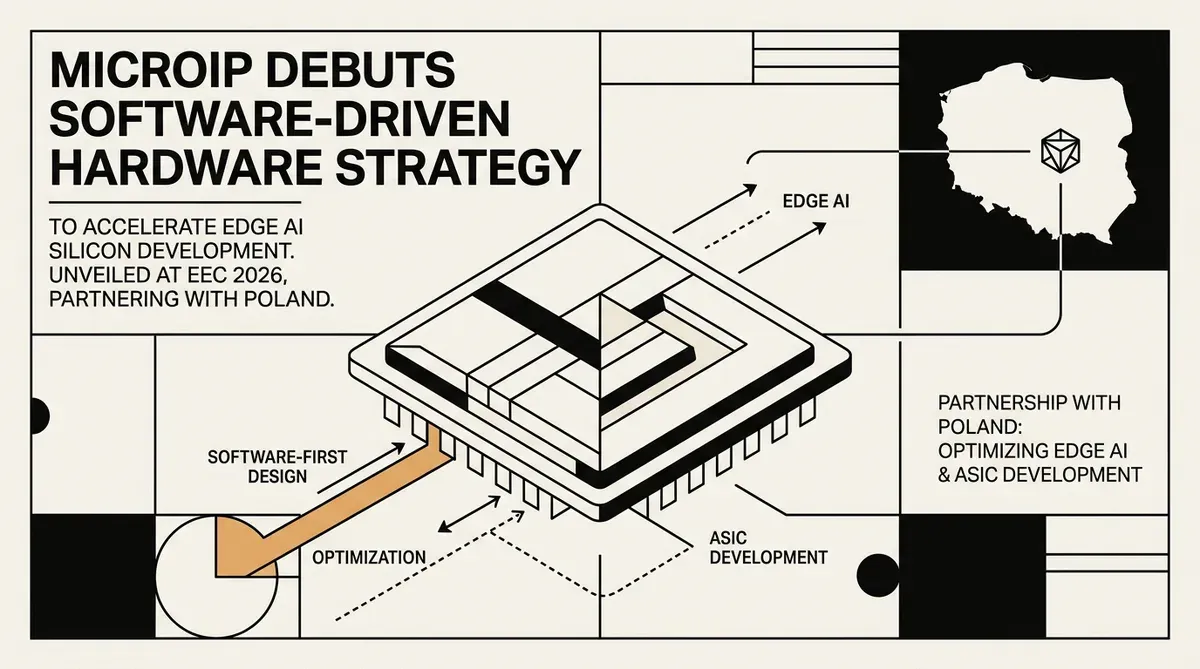
MICROIP has introduced a new strategic framework called Software-Driven Hardware, aiming to reshape the development of Edge AI and ASIC technology. Announced at the European Economic Congress (EEC) 2026 in Katowice, Poland, the initiative focuses on using software requirements to dictate silicon design rather than following traditional hardware-first development cycles.
The Software-Driven Hardware strategy relies on two primary technical pillars: the Customized ASIC Design Services (CATS) platform and the AIVO No-Code platform. By integrating these tools, the company intends to streamline the creation of specialized chips that are optimized for low-power consumption and specific artificial intelligence workloads at the edge. This approach allows developers to define the necessary software performance metrics before the underlying hardware is finalized.
Strategic Synergy Between Taiwan and Poland
A central component of this announcement is the formal partnership between Taiwanese hardware expertise and Polish software engineering talent. Dr. James Yang, Chairman of MICROIP, detailed how this collaboration seeks to build a more resilient ASIC supply chain. By leveraging Poland's growing pool of software developers, the company aims to create a feedback loop where software needs directly inform the architecture of next-generation semiconductors.
This move comes at a time when the global semiconductor industry is seeking to diversify supply chains and reduce latency for AI applications. The Software-Driven Hardware model addresses these needs by ensuring that the final silicon is purpose-built for the applications it will run, potentially reducing the time-to-market for enterprise AI solutions.
Impact on Edge AI Deployment
For decision-makers, the shift toward software-defined silicon is a change in how Edge AI infrastructure is procured and deployed. Traditional off-the-shelf components often carry overhead that is unnecessary for specific industrial or consumer tasks. The CATS and AIVO No-Code platforms are designed to lower the barrier to entry for companies requiring custom silicon without the massive overhead typically associated with ASIC development.
The focus on low-power Edge AI is particularly relevant for sectors like autonomous manufacturing and smart infrastructure, where energy efficiency is as critical as raw processing power. As of May 2026, MICROIP is positioning this Taiwan-Poland alliance as a blueprint for future international cooperation in the semiconductor sector, emphasizing localized software integration as a key differentiator in the global market.
While we strive for accuracy, bytevyte can make mistakes. Users are advised to verify all information independently. We accept no liability for errors or omissions.
AI-generated image.
Related Articles
- Intel CEO Lip-Bu Tan to Reveal AI Computing Strategy at Computex 2026 Keynote
- Intel, Dell, and Nokia Unveil High-Efficiency 5G Far-Edge Network Solution
- Meta, Broadcom Extend Custom AI Silicon Partnership
✔Human Verified