
Microsoft and Amazon Commit $45 Billion to Australian AI Infrastructure Investment
Microsoft and Amazon lead a $45B Australian AI infrastructure investment surge, as OpenAI plans a massive Sydney AI factory amid rising energy concerns.
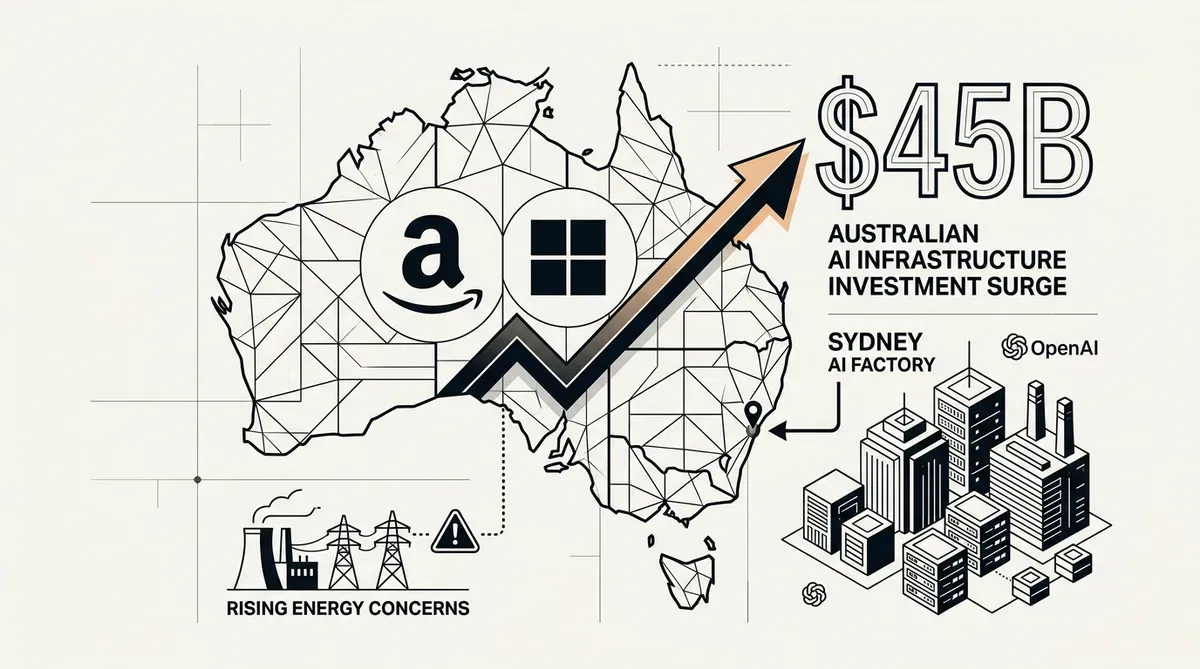
Microsoft and Amazon are investing a total of $45 billion to expand data capacity in Australia. This Australian AI infrastructure investment includes $25 billion from Microsoft and $20 billion from Amazon Web Services (AWS). These commitments coincide with a partnership between OpenAI and NextDC to build a 650-megawatt AI factory at Eastern Creek in Sydney. These projects are part of a broader effort by technology companies to establish the hardware needed for machine learning models in the Asia-Pacific region.
Australia is currently the second-largest market for data center investment in the world, following the United States. The Sydney project provides the high-density compute environment required for large-scale model training. This concentration of hardware ensures the local market can support generative AI applications. According to industry data, the scale of these investments is the largest ever recorded for the Australian digital sector.
Economic and Regulatory Impact of Infrastructure Growth
The growth in Australian AI infrastructure investment allows local businesses and government agencies to process data within national borders. Domestic hosting helps organizations meet data sovereignty rules and reduces latency. This is a factor for the finance and healthcare sectors, where data location is a compliance requirement. The OpenAI-backed facility provides local developers with access to advanced hardware for testing new models.
The expansion of these data centers creates new demands on the national electricity grid. Energy analysts suggest the increased load could raise power prices for other consumers. Some estimates indicate electricity costs could rise by 26 percent due to the surge in demand. This creates a conflict between technological expansion and the availability of affordable energy for the general public.
Corporate planners are evaluating the impact of these facilities on long-term operational costs. While high-performance computing speeds up innovation, rising energy prices are a financial risk. Companies are looking at energy-efficient AI models to manage utility expenses. The volume of Australian AI infrastructure investment is also increasing competition for workers with expertise in data center operations and hardware management.
The Australian government is working to reconcile this infrastructure growth with national emissions targets. By June 2026, the industry is expected to focus on connecting these facilities to renewable energy sources. Grid stability will depend on the deployment of on-site battery storage and power purchase agreements with wind and solar providers. These measures are necessary to support the aggressive construction schedules set by Microsoft and Amazon.
While we strive for accuracy, bytevyte can make mistakes. Users are advised to verify all information independently. We accept no liability for errors or omissions.
AI-generated image.
Related Articles
- OpenAI Shifts Enterprise Strategy to Amazon Bedrock Citing Microsoft Partnership Constraints
- Meta Increases 2026 Capital Expenditure to $145 Billion for AI Infrastructure
- Amazon Projects $200 Billion AI Infrastructure Spend as AWS AI Revenue Hits $15 Billion Run Rate
✔Human Verified