
Microsoft Chevron Power Deal Brings 20-Year Behind-the-Meter Supply to AI Data Center Campus
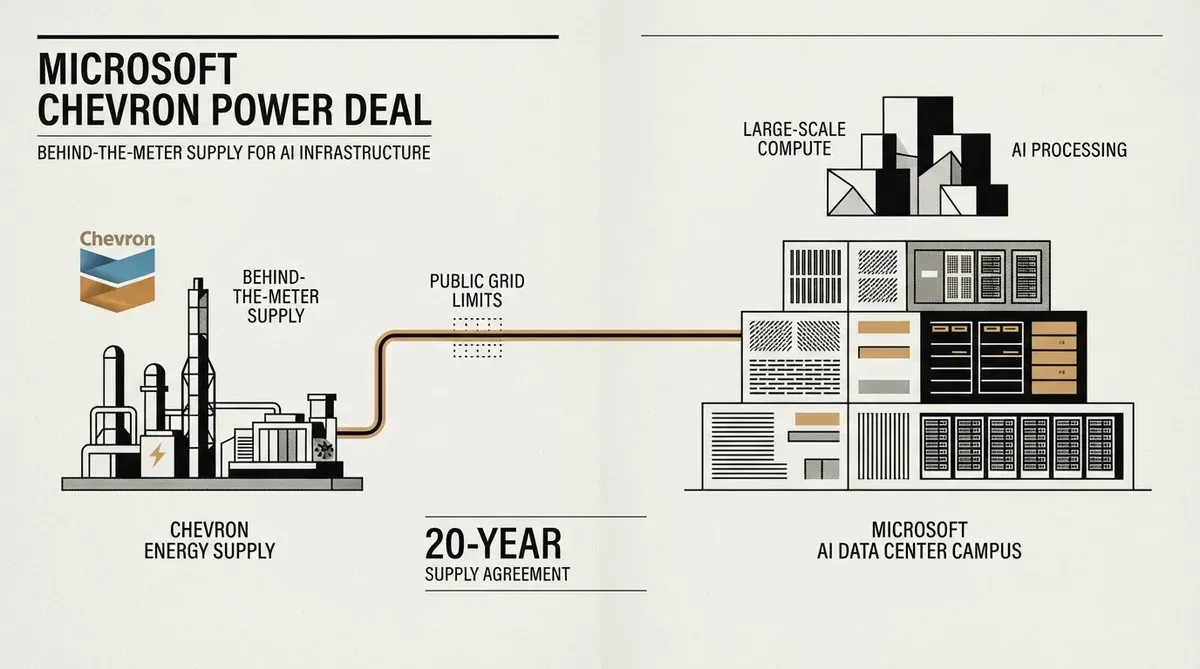
Microsoft and Chevron have signed a 20-year behind-the-meter power supply deal to serve an AI data center campus, marking one of the longer-term energy commitments in the fast-growing AI infrastructure sector. The agreement is structured as a direct-wire connection rather than a grid-tied procurement, giving Microsoft a dedicated electricity source that bypasses the broader transmission network.
Behind-the-meter arrangements allow an energy producer to deliver power directly to a consumer without routing through the bulk grid. For Microsoft, this means the electricity flowing to its AI data center campus avoids transmission bottlenecks and grid capacity constraints that have become a pressing concern for large-scale data center operators. The 20-year term suggests both parties expect sustained demand for AI compute capacity through the mid-2040s.
This Microsoft Chevron power deal reflects how energy-intensive AI workloads are reshaping the relationship between major technology companies and energy producers. Direct supply agreements of this duration anchor long-term revenue for the energy provider while giving the tech firm power cost predictability and supply security that standard grid connections cannot guarantee. Chevron, primarily known as an oil and gas producer, gains a foothold in the growing market for dedicated industrial power supply to the technology sector.
As AI data center campuses continue to scale in both size and energy consumption, behind-the-meter arrangements may become a more common fixture of the infrastructure sector. The deal also raises questions about the broader grid implications: large customers removing their load from the public network reduces the rate base over which fixed infrastructure costs are spread, potentially shifting costs onto remaining residential and small business ratepayers.
Cost predictability over 20 years is an attractive proposition for a company investing billions in AI compute infrastructure where electricity is one of the largest variable operating expenses. For Chevron, the agreement is a diversification play into electricity sales to technology clients, a channel that may grow alongside the continued expansion of AI workloads.
Why this matters
The Microsoft-Chevron deal signals that energy strategy is now a first-order concern for AI infrastructure planning, not a secondary operational detail. Behind-the-meter power agreements shift the economics of data center siting: locations near generation capacity gain an edge over locations near grid interconnection points. If this model scales, it could reshape where the next generation of AI data centers are built and who controls the energy supply chains that power them.
AI-generated image.
Related Articles
- Google and Intersect Power Launch Meitner Energy Center for AI Infrastructure in Texas
- Applied Digital Secures $5.2 Billion AI Data Center Lease with Hyperscaler
- US Data Center Electricity Demand Rises as AI Infrastructure Spending Hits $725 Billion
✔Human Verified
Researched and cross-referenced against primary sources by the Bytevyte editorial team.