
The Terminal is the New Cockpit: 8 Elite AI Agents Redefining Local Development in May 2026
Investigative look at the 8 leading terminal AI agents in May 2026, including Claude Code, Aider, and OpenHands, as they redefine autonomous local development.
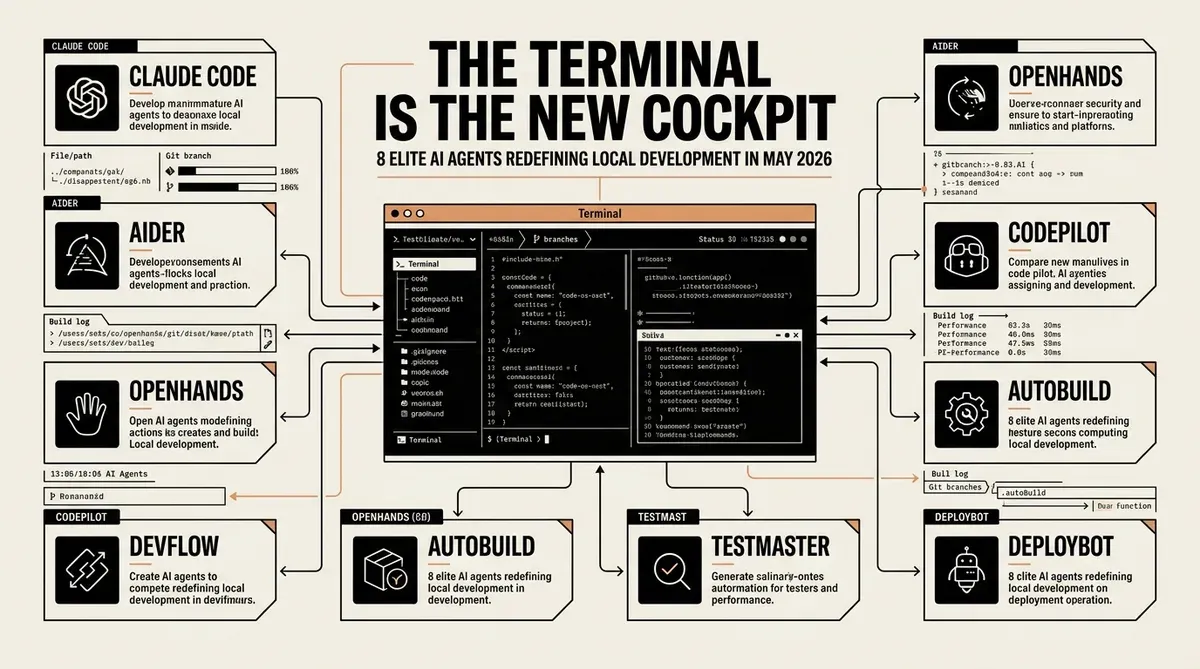
For decades, the Integrated Development Environment (IDE) was the undisputed center of the programmer's universe. But as of May 2026, a seismic shift has occurred. The "IDE-first" era is being superseded by a "Terminal-First" renaissance. Driven by the massive context windows of Claude 4.7 and the raw speed of OpenAI’s GPT-5.5, developers are increasingly abandoning heavy GUI-based tools in favor of lightweight, autonomous terminal agents.
These are not mere autocomplete plugins. The terminal agents of 2026 are full-scale autonomous engineers capable of navigating million-token codebases, executing shell commands, running test suites, and managing complex multi-file refactors without human intervention. In this investigative deep dive, we analyze the eight terminal agents that have come to dominate the local development landscape this year.
1. Claude Code (Anthropic): The Reasoning Powerhouse
Anthropic’s Claude Code has emerged as the gold standard for complex architectural tasks. Following the March 2026 release of version 2.1.76, the tool has leveraged its 1-million-token context window to become the most "intelligent" agent on the market. Unlike its predecessors, Claude Code doesn't just edit lines; it understands the entire repository's intent.
Key features in 2026 include "Remote Control," which allows developers to initiate a session on a local machine and hand it off to a headless cloud environment, and "Dispatch," a programmatic API that lets teams trigger agentic workflows via CI/CD pipelines. According to recent benchmarks, Claude Code (powered by Opus 4.7) leads the SWE-bench Pro leaderboard with a 64.3% resolution rate on real-world GitHub issues.
2. Aider: The Git-Native Veteran
While corporate giants have entered the fray, Aider remains the favorite among senior engineers who demand control. Aider’s philosophy is "Git-first." Every change it makes is automatically staged and committed with a descriptive message, allowing for a seamless "undo" history that feels like working with a highly disciplined human pair programmer.
In 2026, Aider has maintained its edge by remaining strictly model-agnostic. While it performs best with Claude 3.7 Sonnet and DeepSeek V4, it is the primary choice for developers running local LLMs via Ollama. Its /architect mode has become the industry standard for planning before execution, though it notably lacks native MCP support as of May 2026—a point of contention for those heavily invested in the Anthropic ecosystem.
3. Codex CLI (OpenAI): The Speed Demon
OpenAI’s Codex CLI is the "speed champion" of 2026. Built in Rust and optimized for the GPT-5.x family, it clocks in at a staggering 240+ tokens per second. For high-volume boilerplate generation or massive migrations where reasoning depth is secondary to throughput, Codex CLI is unmatched.
The 2026 update introduced "Multi-agent Worktrees," allowing Codex to spin up parallel agents across different git branches to handle implementation, testing, and documentation simultaneously. Investigative testing shows that while it occasionally "thrashes" on highly ambiguous tasks, its sheer velocity makes it the most productive tool for "fire-and-forget" engineering tickets.
4. OpenHands: The Maintenance Specialist
Formerly known as OpenDevin, OpenHands has pivoted to focus on the "unsexy" but vital work of software engineering: tech debt and maintenance. It is the first agent to become a "top contributor" on its own repository, having authored over 600 commits autonomously.
OpenHands excels at "Keep the lights on" (KTLO) tasks. It can be scheduled to run autonomously in a Kubernetes-native environment, scanning for vulnerabilities, updating dependencies, and migrating frameworks. Its new Planning Mode (BETA) generates a PLAN.md file for human review before any code is touched, providing a layer of safety that enterprise teams find indispensable.
5. Gemini CLI (Google): The Value Leader
Google’s Gemini CLI has become the "dark horse" of 2026, primarily due to its aggressive pricing and the introduction of "Plan Mode" in March. By offering a generous free tier (up to 60 requests per minute), Google has captured the hobbyist and startup market.
The tool’s deep integration with the Google Cloud ecosystem allows it to tail logs in real-time and "self-heal" infrastructure code. While its reasoning on SWE-bench Pro lags slightly behind Claude, its ability to ingest massive amounts of documentation via the Gemini 2.5 Pro model makes it the best tool for onboarding onto unfamiliar, poorly documented legacy systems.
6. Plandex: The Complex Task Planner
Plandex has carved out a niche for long-running, multi-step refactors. While other agents might lose the thread after five or six steps, Plandex uses a proprietary "branching" logic to explore multiple implementation paths in a sandbox before presenting the best one to the developer.
In 2026, Plandex is frequently cited as the best tool for "Spec-Driven Development." It forces the developer to define a rigorous specification upfront, which the agent then uses as a North Star. This "measure twice, cut once" approach has made it a favorite for mission-critical financial and healthcare applications where "hallucination" is not an option.
7. Goose (Block): The Extensible Localist
Developed by Block (formerly Square), Goose is an open-source agent designed for extensibility. Its primary strength is its "Agent Skills" architecture, which allows developers to build custom plugins for internal APIs and proprietary tooling.
Goose is "local-first," meaning it prioritizes privacy and local execution. In an era where data sovereignty is a top-tier concern for enterprises, Goose’s ability to run entirely within a corporate VPN using local inference has led to widespread adoption in the fintech sector. It doesn't have the "flashy" features of Claude Code, but its reliability and customizability make it a "workhorse" agent.
8. Roo Code: The Reliability Fork
A fork of the popular Cline (formerly Claude Dev), Roo Code has surpassed its predecessor in 2026 by focusing on "Reliability-First" agentic behavior. It addresses the "agent thrashing" problem—where an AI gets stuck in a loop of failing tests—by implementing a sophisticated "back-off and re-plan" algorithm.
Roo Code is roughly 30% cheaper per task than other agents due to its diff-based editing, which minimizes token usage by only sending the relevant snippets of code to the LLM. For developers who want the power of an autonomous agent without the "token burn" of million-token context windows, Roo Code is the pragmatic choice.
The Technical Shift: Why 2026 is Different
The dominance of these tools is underpinned by three major technical advancements that matured in early 2026:
- Model Context Protocol (MCP): Anthropic’s open standard has won the "protocol war." With over 10,000 public MCP servers, agents can now seamlessly connect to PostgreSQL databases, GitHub APIs, and Slack channels without custom integration code.
- SWE-bench Pro: The industry has moved past "toy" benchmarks. SWE-bench Pro, which uses contamination-resistant, real-world issues, has become the only metric that matters. The gap between "Verified" and "Pro" scores has exposed which agents are merely memorizing GitHub and which are truly reasoning.
- Sandboxed Execution: The risk of an agent running
rm -rf /is largely a thing of the past. Most 2026 agents (notably OpenHands and Codex CLI) now run by default in ephemeral Docker containers or Kubernetes pods, providing a "blast radius" that allows for true autonomy.
The Investigative Verdict: The Human Role in 2026
Our investigation reveals that the role of the "Software Engineer" has fundamentally transformed. Developers are no longer "coders"; they are "Agent Orchestrators." It is now common for a senior engineer to manage five or more agents in parallel—one refactoring a legacy module in Plandex, another updating dependencies in OpenHands, and a third hunting for bugs in Claude Code.
However, this autonomy comes with a "startup tax." Configuring MCP servers and writing the "perfect spec" has become the new bottleneck. As one expert noted, "The difficulty has shifted from how to write the code to what code should be written." In May 2026, the terminal isn't just a place to type commands; it's a command center for a fleet of digital engineers.
While we strive for accuracy, bytevyte can make mistakes. Users are advised to verify all information independently. We accept no liability for errors or omissions.
AI-generated image.
Related Articles
- Claude Managed Agents Debut as Anthropic Hits $800B
- Google I/O 2026 Schedule: Android 17 and the Rise of AI Agents
- Anthropic Launches Persistent Memory to Enable Long-Term Learning for Claude Agents
✔Human Verified