
Apple OpenAI Trade Secrets Lawsuit: Hardware Talent Fight
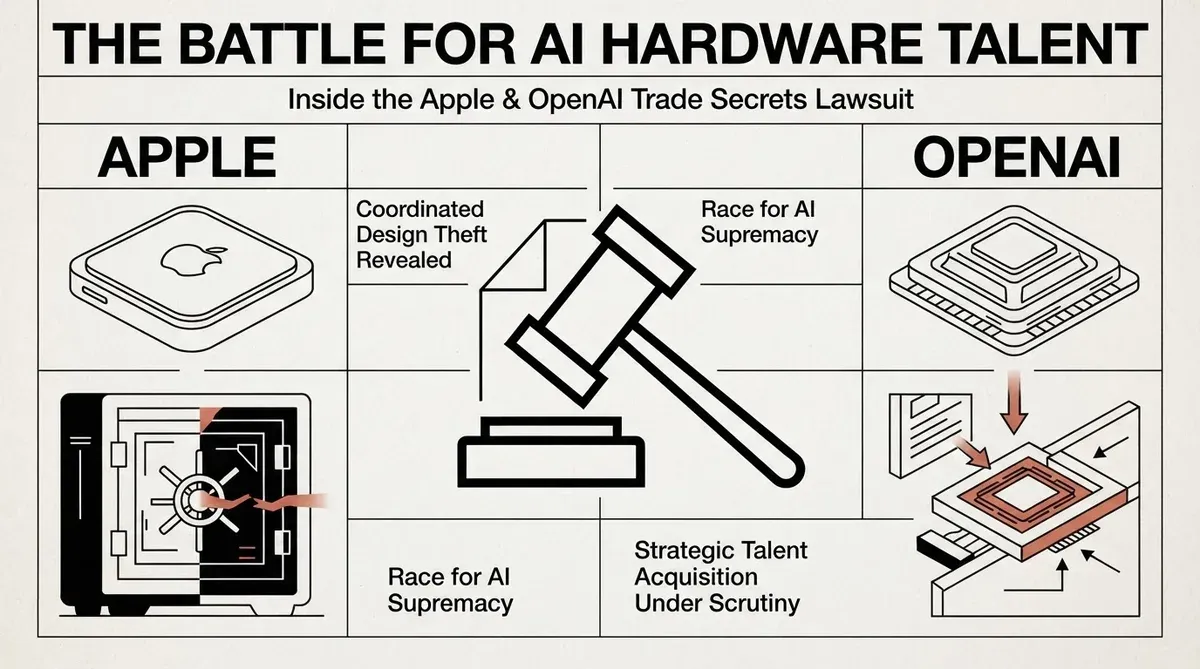
Apple's decision to sue OpenAI for trade secret theft opens a new front in the escalating battle over AI hardware talent and intellectual property. The Apple OpenAI trade secrets lawsuit, filed July 10 in the U.S. District Court for the Northern District of California, names OpenAI and two former employees alongside io Products, the Jony Ive-founded startup OpenAI acquired last year for $6.5 billion.
The two former Apple employees at the center of the case are Tang Yew Tan, a former vice president of product design for iPhone and Apple Watch who is now OpenAI's Chief Hardware Officer, and Chang Liu, a former senior system electrical engineer. Also named as defendants are OpenAI Foundation, OpenAI Group PBC, and io Products.
I have covered technology long enough to know that most corporate trade secret lawsuits are noise — legal posturing that fades into a confidential settlement. This one demands closer attention. The allegations describe a pattern of conduct that, if proven, would suggest OpenAI's hardware ambitions were built on a foundation of systematic Apple IP appropriation.
The Tan Allegations
Tan spent 24 years at Apple before joining OpenAI. Apple's complaint alleges he used Apple's confidential project code names during the recruiting process, asked job candidates to bring Apple hardware components to their interviews, coached departing Apple employees on evading security procedures, and solicited details about unannounced Apple products. Apple claims this behavior was normalized and exemplified by OpenAI leadership.
These accusations matter because Tan is not a junior engineer. As Chief Hardware Officer at OpenAI, he is responsible for building the company's hardware strategy from the ground up. If the allegations are accurate, OpenAI's hardware division was built using Apple's roadmap as a blueprint.
The Liu Case
Liu's alleged actions are more straightforward. Apple says he failed to return a company-issued laptop after leaving and later exploited an authentication bug to access Apple's internal network, downloading dozens of confidential hardware-related files. This is the kind of technical breach that is easier to prove in court.
More than 400 former Apple employees now work at OpenAI, according to Apple's filing. That number is a staggering concentration of institutional knowledge about Apple's supply chain, manufacturing methods, and design processes. The Apple OpenAI trade secrets lawsuit is fundamentally about whether that knowledge can be legally separated from the specific documents and data Apple claims were stolen.
Strategic Implications of the Apple OpenAI Trade Secrets Lawsuit
OpenAI is widely believed to be developing its first hardware product, and analyst Ming-Chi Kuo has suggested the device could use AI agents instead of traditional apps. The io Products acquisition gave OpenAI access to world-class design talent. The hiring spree from Apple gave it deep hardware engineering expertise. If Apple's suit succeeds in blocking OpenAI from using its trade secrets, it could significantly slow the company's hardware timeline.
For Apple, the calculus is defensive but necessary. The company has long relied on the tight integration of hardware and software as its primary competitive advantage. A rival that can replicate Apple's supply chain relationships, manufacturing efficiency, and design sensibility could erode that moat faster than any software competitor ever has.
The counter-argument, and it is a strong one, is that general expertise is not a trade secret. Silicon Valley runs on talent mobility. Engineers change companies and bring their skills with them. The line between applying general knowledge and using specific confidential information is the central legal question this case will test.
Why this matters
The Apple OpenAI trade secrets lawsuit is the most direct confrontation yet between the two companies, and its outcome will set binding precedent for how AI hardware talent wars are fought. If Apple secures the injunction it seeks, OpenAI's hardware ambitions face a serious legal obstacle. If OpenAI prevails, it gains license to continue raiding Apple's engineering ranks. The rules of competition for the next generation of AI-powered devices are being written in this courtroom right now.
AI-generated image.
Related Articles
- IBM and Arm Join Forces for Dual-Architecture AI Hardware Innovation
- Apple Expands Private Cloud Compute to Google Cloud via NVIDIA Confidential Computing
- Foxconn Ransomware Attack: Nitrogen Group Claims Theft of Apple and NVIDIA Schematics
✔Human Verified
Researched and cross-referenced against primary sources by the Bytevyte editorial team.