
Humanoid Robots Enter EV Production as UBTECH Walker S1 Joins Zeekr Factory
UBTECH Walker S1 humanoid robots begin industrial tasks at Zeekr's EV factory, marking a shift toward flexible automation in manufacturing.
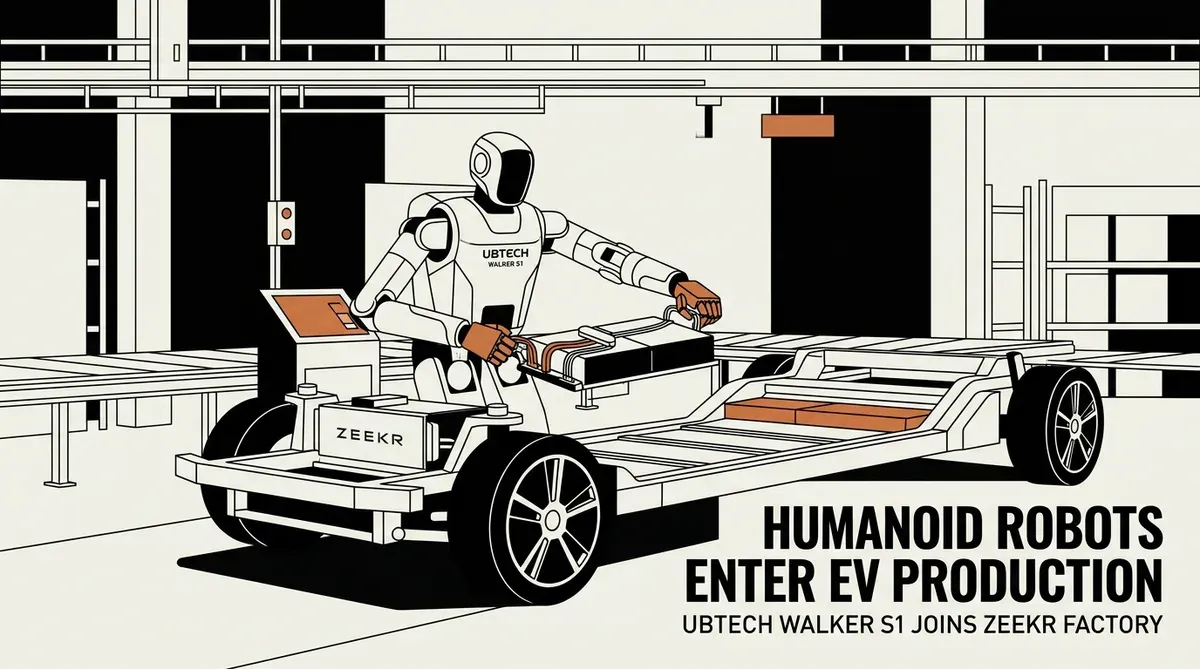
UBTECH Walker S1 humanoid robots have officially entered the production line at the Zeekr electric vehicle factory in Ningbo, marking a significant step in the commercialization of bipedal automation. This deployment involves the robots performing complex tasks such as component sorting and box lifting within a 5G-enabled manufacturing environment. UBTECH has set an ambitious production target of 1,000 units by 2025 to meet growing demand for flexible industrial automation.
The integration of the UBTECH Walker S1 into the Zeekr facility addresses critical labor shortages while targeting roles that are either hazardous or highly repetitive. Unlike traditional industrial robots that are often fixed in place, these humanoid systems provide the mobility and adaptability required for non-linear factory workflows. This shift toward physical AI allows manufacturers to automate segments of the assembly process that previously required human dexterity and spatial awareness.
Strategic Implications for Manufacturing
The move by Zeekr to adopt humanoid technology highlights a broader trend among industrial leaders seeking to optimize logistics and assembly. Companies such as Accenture, Vodafone, and SAP have also initiated trials with humanoid robots in warehouse settings. These organizations are focusing on improving operational efficiency and safety by delegating physically demanding tasks to autonomous systems. The use of 5G connectivity at the Ningbo plant ensures the low-latency communication necessary for these robots to operate safely alongside human workers.
For decision-makers, the deployment of the UBTECH Walker S1 is a transition from experimental pilots to functional utility. The ability of these robots to handle varied tasks suggests that the return on investment for humanoid platforms is becoming more tangible. As production scales toward the 1,000-unit milestone, the cost per unit is expected to decrease, making the technology accessible to a wider range of industrial sectors beyond high-end automotive manufacturing.
The success of the UBTECH Walker S1 at Zeekr will likely serve as a benchmark for the industry. As of May 2026, the focus remains on refining the interaction between human staff and robotic counterparts. Future developments will likely involve deeper integration of generative AI to improve the decision-making capabilities of these machines on the factory floor.
While we strive for accuracy, bytevyte can make mistakes. Users are advised to verify all information independently. We accept no liability for errors or omissions.
AI-generated image.
Related Articles
- Automotive Supplier Martur Fompak Links SAP Joule to Humanoid Robots for Intralogistics
- Unitree GD01: China's First Mass-Produced Manned Transforming Mecha Launches
- Siemens Deploys HMND 01 Alpha Humanoid Robots with NVIDIA
✔Human Verified