
HCLTech Warns 43% of Enterprise AI Initiatives Face High Failure Risk as Execution Gaps Widen
HCLTech report finds 43% of enterprise AI initiatives risk failure due to execution gaps and legacy infrastructure constraints in large organizations.
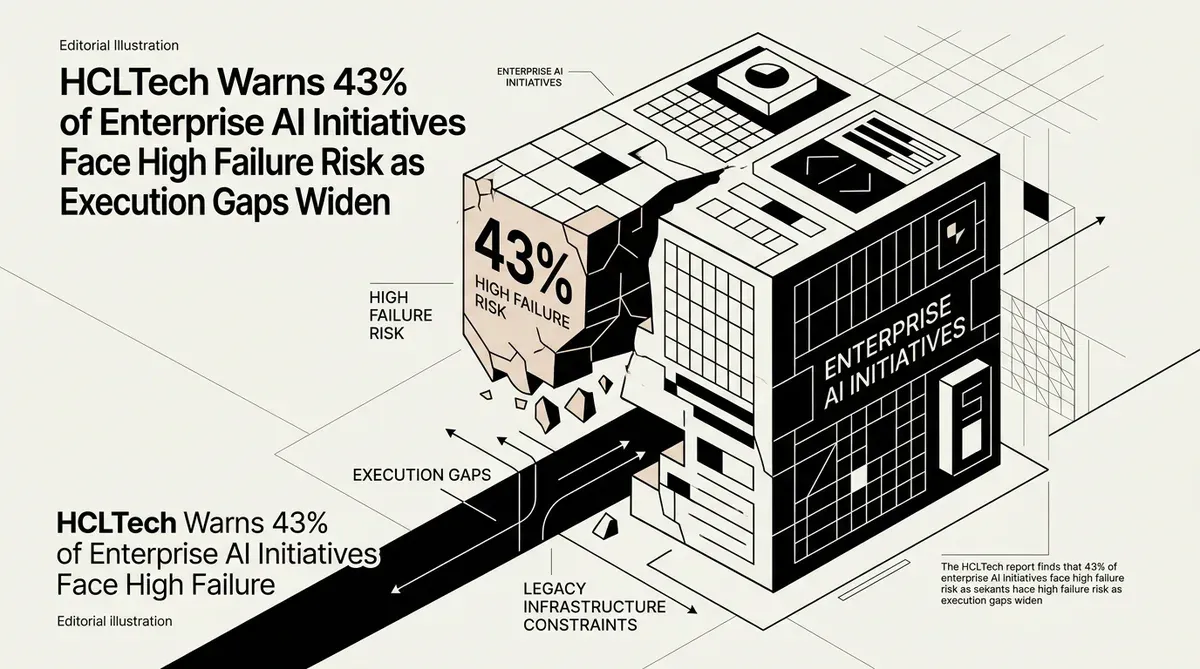
HCLTech has released a comprehensive market report revealing that 43% of enterprise AI initiatives are at high risk of failure as organizations struggle to move beyond the experimental phase. The study, titled The AI Impact Imperatives, 2026, highlights a widening execution gap where the initial excitement of pilot programs meets the reality of scaling autonomous systems within legacy environments.
The findings are based on a global survey of 467 senior executives at companies generating more than $1 billion in annual revenue. According to the data released this week, the primary challenge is not a lack of access to advanced tools but the difficulty of translating corporate ambition into reliable, repeatable outcomes. This pressure is compounded by aggressive timelines, with 50% of leaders expecting to see measurable value from their enterprise AI initiatives within just 18 months.
Structural Barriers to Scaling AI
For Chief Information Officers, the report identifies that the push for enterprise AI initiatives is exposing deep-seated structural flaws. Existing application estates, data architectures, and operating models were largely built for manual or deterministic processes rather than the fluid requirements of autonomous agents. As these organizations attempt to integrate AI at scale, these legacy constraints act as significant bottlenecks that threaten the viability of multi-million dollar investments.
The research suggests that the risk of failure stems from three specific areas:
- Fragmented data environments that prevent models from accessing high-quality, real-time information.
- Operating models that lack the agility to manage AI-driven workflows.
- Legacy software stacks that are incompatible with modern autonomous system requirements.
Strategic Implications for Decision-Makers
The high failure rate suggests that enterprise AI initiatives require a fundamental shift in strategy. Rather than focusing solely on model selection or prompt engineering, successful organizations are likely to be those that prioritize the modernization of their underlying data and application infrastructure. The 18-month ROI window expected by half of the surveyed executives creates a high-stakes environment where technical debt can quickly derail progress.
HCLTech notes that the transition from experimentation to production is where most projects stall. To mitigate these risks, the report advises leaders to address the execution gap by aligning their technical architecture with the specific demands of generative and autonomous technologies. Without this alignment, the disconnect between executive expectations and technical reality will continue to grow, potentially leading to a cooling of AI investment if early projects fail to deliver the promised returns.
While we strive for accuracy, bytevyte can make mistakes. Users are advised to verify all information independently. We accept no liability for errors or omissions.
AI-generated image.
Related Articles
- Lenovo Study Finds Unregulated Enterprise Shadow AI Risks Corporate Security and ROI
- Enterprise AI Governance Failures Force Rollbacks for 74% of Live Agents
- Genpact Report: 92% of Executives Forecast Agentic AI Will Reshape Corporate Workflows
✔Human Verified