
Intel America 250 Initiative: Chip Production and AI Education
Intel America 250 initiative expands domestic chip production across five states, launches K-12 AI education, and introduces secure government AI solutions.
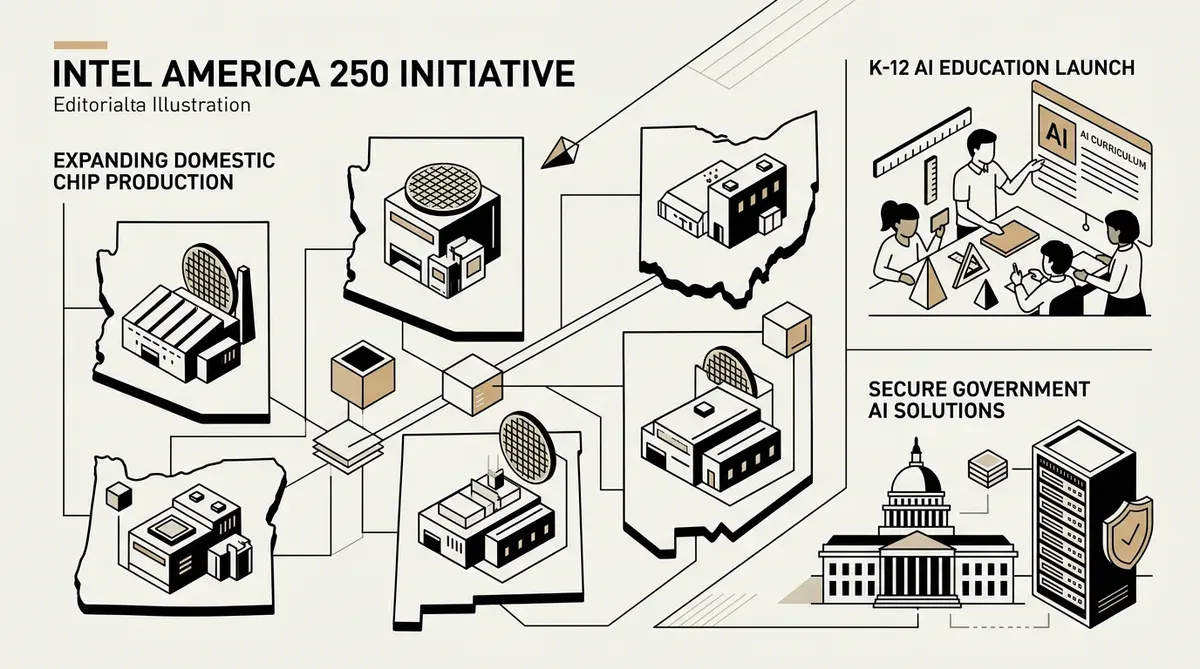
The Intel America 250 initiative, marking the United States' 250th anniversary, ties together domestic chip production, artificial intelligence education, and government-grade AI infrastructure. The plan, unveiled this week in partnership with the America250 nonpartisan organization, spans semiconductor manufacturing investments across five states, a K-12 AI readiness program, and a dedicated secure-AI offering for the public sector.
The Intel America 250 initiative centers on Intel's systems foundry model. The company is continuing its domestic fabrication expansion across existing sites in Oregon, Arizona, New Mexico, and California while advancing plans for a new Ohio facility. These manufacturing hubs are the physical foundation for what Intel describes as secure, sovereign AI infrastructure, a framing that directly addresses federal concerns about chip supply chains and data sovereignty.
Manufacturing Footprint and National Security Implications
The foundry expansion gives Intel a geographic distribution of advanced-node capacity that no other domestic chipmaker currently matches. With fabrication plants spanning the West Coast, Southwest, and Midwest, the company's production network reduces single-point-of-failure risks that have troubled defense and intelligence agencies reliant on overseas fabrication. This diversification carries weight as export controls on advanced semiconductors tighten and the federal government seeks trusted domestic sources for AI-training hardware.
Intel's systems foundry approach combines chip design, advanced packaging, and manufacturing under one roof. This vertical integration is central to its value proposition for government clients. By controlling the full stack, Intel can offer assurance that sensitive designs never leave U.S. jurisdiction, a requirement that is becoming standard in federal AI procurement. The USAI initiative, announced alongside the America 250 program, formalizes this offering by providing secure and responsible AI solutions for government and public-sector use cases.
AI-Ready Schools: Workforce Pipeline from K-12
On the education front, the Intel America 250 initiative includes Intel's AI-Ready Schools Initiative, which will deploy 500 AI-capable personal computers to 250 K-12 schools and deliver more than 750 hours of teaching content. The program targets a pipeline problem that the semiconductor industry has flagged for years: a shortage of talent trained to work with AI tools and hardware. By putting AI PCs into classrooms and training educators, with the company having committed to a tenfold expansion of educator training, Intel is seeding its own future labor pool while addressing a national skills gap.
The initiative does not stop at K-12. Intel is allocating $250,000 in grants for community college AI bootcamps through its program for youth in the child welfare system. This dual approach of reaching students at both the secondary and postsecondary levels suggests a deliberate strategy to broaden the talent funnel beyond the traditional four-year university track. For business leaders, the implication is clear: the domestic AI workforce of the late 2020s and early 2030s will increasingly be shaped by corporate-led training investments rather than conventional academic pathways alone.
Community Investment and Corporate Recognition
Intel's America 250 initiative arrives alongside corporate recognitions in 2026. The company has been named to Fortune's list of America's Most Innovative Companies, TIME's World's Best Companies ranking, and the American Opportunity Index, which measures how well large employers drive economic mobility for their workers. These accolades reinforce the narrative that Intel is positioning itself as an anchor institution for U.S. technological competitiveness, not just a chip supplier.
The strategic logic connecting these recognitions to the America 250 rollout is straightforward. For Intel to win long-term government contracts and attract top engineering talent, it needs a public reputation that matches its technical ambitions. An education program serving hundreds of schools and a workforce initiative targeting vulnerable youth build brand equity that cannot be bought through product marketing alone.
Why It Matters for Decision-Makers
For technology leaders and strategists, the Intel America 250 initiative signals several developments worth tracking. First, the company is betting heavily that government AI procurement will favor vertically integrated domestic suppliers over fabless designers who rely on Asian foundries. If that bet pays off, Intel could reclaim lost market share in data center AI accelerators, a segment where it has trailed competitors in recent years.
Second, the education investments create a long-term talent pipeline that competing chipmakers will be hard-pressed to replicate. Intel's early exposure to K-12 students through AI PCs and curricula sets the stage for a generation of engineers and developers familiar with Intel hardware before they enter the workforce. For CTOs evaluating AI hardware procurement in the late 2020s, the availability of talent trained on a particular platform is a meaningful factor in vendor selection.
Third, the USAI initiative signals that the market for sovereign AI infrastructure (systems designed, manufactured, and operated within a single country's borders) is maturing. Governments in the U.S., Europe, and Asia are increasingly demanding AI systems that comply with local data sovereignty laws and national security requirements. Intel's early positioning in this market could give it a first-mover advantage as similar requirements spread to allied nations.
Broader Industry Context
The Intel America 250 initiative arrives at a moment when semiconductor policy has become a bipartisan priority in Washington. The CHIPS Act has allocated billions in subsidies for domestic fabrication, but translating that funding into operational capacity has proven slower than many policymakers anticipated. Intel's manufacturing timeline, with the Ohio facility still in planning stages, illustrates the gap between policy ambition and industrial reality. Foundry construction takes years, and even existing sites require continuous investment to upgrade equipment and processes.
Meanwhile, competitors are not standing still. Taiwan Semiconductor Manufacturing Company continues to build out its Arizona facilities, and Samsung is expanding in Texas. The race for domestic AI chip production is multipolar, and the Intel America 250 initiative is as much a marketing campaign for its foundry model as it is a substantive program. The real test will come when these facilities reach volume production and customers must choose between Intel's integrated approach and the pure-play foundries that have dominated the market for the past decade.
The Intel America 250 initiative gives Intel a patriotic framework for communicating its strategy, but the underlying business logic is straightforward: capture the government AI market, build a talent pipeline that competitors cannot match, and position the foundry model as the secure alternative to offshore fabrication. For decision-makers in both the public and private sectors, the initiative offers a concrete case study in how a legacy semiconductor company is attempting to reinvent itself for the AI era.
Sources
AI-generated image.
Related Articles
- Intel and Musk Unite for $25 Billion Terafab AI Chip Manufacturing Venture
- Intel Surpasses $300 Billion Valuation and Confirms Intel Terafab Partnership
- Intel Unveils Rackscale AI Infrastructure to Power Enterprise Autonomous Agents
✔Human Verified
Researched and cross-referenced against primary sources by the Bytevyte editorial team.